

(21.11.2025–03.05.2026)
Muzeum Sztuki Nowoczesnej w Warszawie / Museum of Modern Art in Warsaw
Organized by curator and art historian Alison M. Gingeras, this exhibition challenges the notion that women were largely absent from art before the late 1800s. The nine-part visual narrative is a testament to the enduring and dynamic creativity of women artists over the last 500 years. The result is a collection of nearly 200 works, including paintings by Renaissance, Baroque and 19th-century women artists through more contemporary works, offering a centuries-long visual history of women’s “emancipation.”
Curator: Alison M. Gingeras
Cooperation: Ewa Klekot, Beata Purc

GUESTS
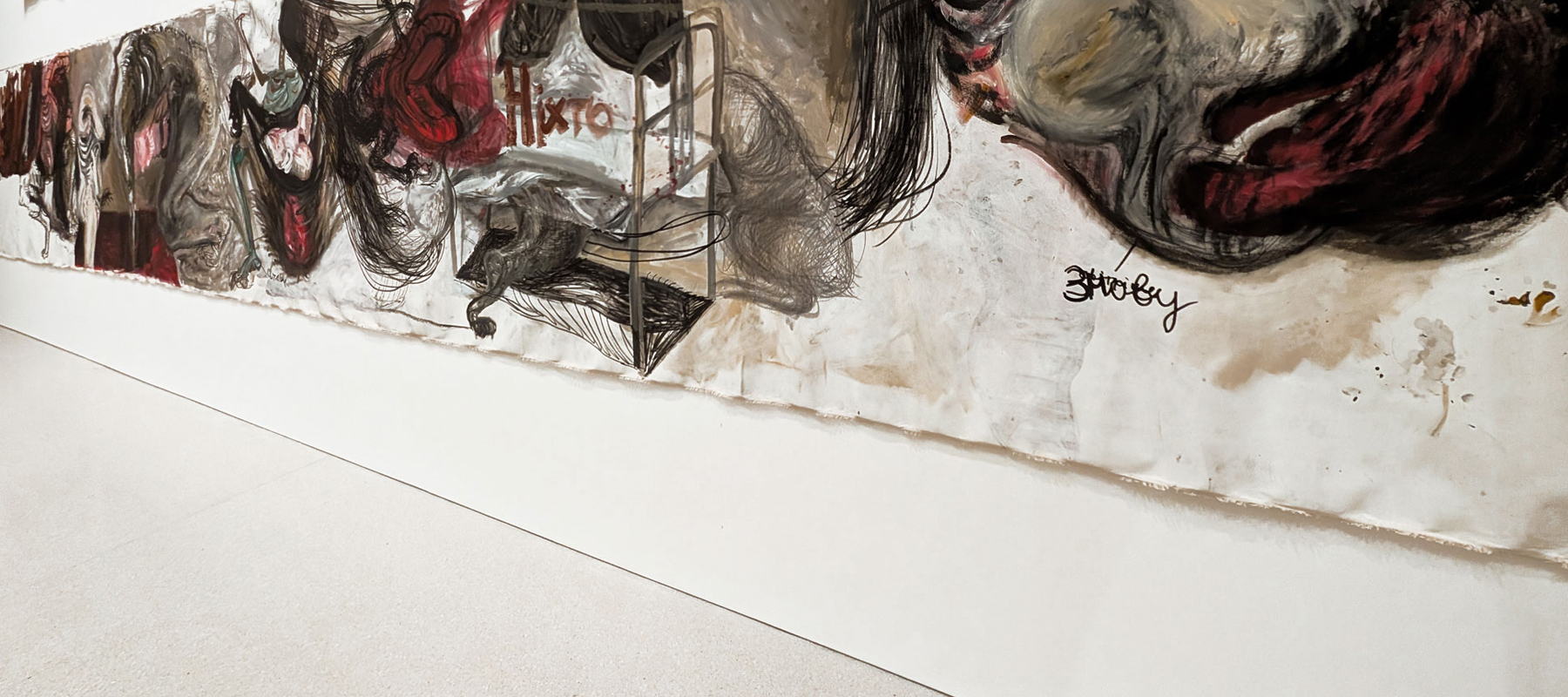
The emotionally charged and inherently political paintings of Kyiv-based artist Vlada Ralko expose the brutal essence of violence in Russia's war.
Since the 2013 Revolution of Dignity, Ralko has been documenting the complex realities faced by Ukrainian society, drawing on historical and cultural layers of Ukraine's prolonged struggle for independence. Her Kyiv Diary was followed by the Lviv Diary, which further developed these themes and introduced a symbolic visual language that has become characteristic of her work.
Ralko's mythology in Guests unfolds across a monumental, scroll-like canvas. Due to its vast size, the artist had to roll and unroll sections as she worked, moving between fragments and revisiting earlier ones. She explains: "The act of folding and unfolding became a physical parallel to the demands I placed on the image. My intention to depict something unseen, unknown, unheard – and obscene in its dreadful impossibility – materialized both in the artwork and in the process, where I could only see part of the surface, holding the rest in memory or imagination."
In her work, atypical figures emerge as the artist frequently merges human and animal body parts, or even portrays individual organs as distinct living organisms. Regardless, they all embody death and suffering. "I was thinking about the animalistic – the 'inhuman' – as a metaphor for actions that a sane, conscious person should be incapable of," Ralko notes.
Language is a central topic in her practice. Letters from the Ukrainian alphabet surface across her canvases, resembling bloody traces of war. Yet for Ralko, language is far more than text – it's a form of shared realism, one that pierces thought and cuts through the body to the bone, regardless of where one physically experiences war. In her paintings, she constructs a visual code that conveys complex emotions, historical trauma, resistance, cultural continuity, and the very fabric of time itself.
Other symbols include the red cross, the bed, strands of women's hair, and a dog's paw. These elements, Ralko explains, create surreal compositions meant to emphasize the horrific realism of war and its capacity to radically distort reality. These symbols sometimes cohere and at other times fragment-lingering like signs waiting for their referents, reflecting the scale and nature of violence and the profound proximity of war.
Kateryna Iakovlenko